
Farmington Records Open to the Public
Utah's Government Records Access and Management Act, known as GRAMA, starts with a presumption that a government record is public unless another rule classifies it as private, controlled, protected, or otherwise restricted. That principle does not place every Farmington record in one database. City departments, Davis County offices, Utah courts, and state agencies each keep their own files.
| Record set | Official keeper | Web access | Other access |
|---|---|---|---|
| Deeds, mortgages, liens, plats | Davis County Recorder | Free Property Search; REDI-Web subscription | Recorder terminal, copies, or targeted request |
| Parcel, value, tax, GIS | Recorder, Assessor, Treasurer | Property Search and county GIS | Recorder, Assessor, or Treasurer counter |
| District and justice cases | Utah State Courts | Paid Xchange search | Free participating courthouse terminal; clerk copy |
| Birth and death certificates | Davis County Health and Utah OVRS | No open current-person index | Qualified application; Archives after public transfer |
| Marriage and divorce | County Clerk, Health, or District Court | Xchange for public divorce docket data | Clerk, certificate application, court file, or Archives |
| Voter registration | Davis County Elections and Utah Elections | Identity-verified personal profile | County or state data request, subject to privacy rules |
| Jail and corrections | Davis County Sheriff and Utah DOC | Current roster and offender search | Agency GRAMA request for other releasable files |
| Business and professional licenses | Utah Commerce and licensing boards | Free entity, license, and discipline searches | Agency verification or list request |
| City permits and administrative files | Farmington City Recorder or department | No comprehensive issued-permit index | Non-police city GRAMA form by address and date |
Sealed, expunged, juvenile, adoption, and civil-commitment court material is not available through the public court search. Recent vital certificates require a qualified relationship and identification. Motor-vehicle personal data is restricted by federal law, while protected voter details and sensitive identifiers remain closed under record-specific rules. An open index also does not guarantee that every source image can be viewed free.
Search Farmington Property Records
The Davis County Property Search is the free starting point for land in Farmington. It connects an address or parcel to the owner, serial number, situs address, legal description, tax link, values, mailing address, property traits, and recorded-document or ownership history. Situs means the physical property location. A mailing address is where tax notices go, so the two may differ.
| Search control | Input | What to know |
|---|---|---|
| Search term | Address or parcel ID | Required; choose an autocomplete result |
| Address | Street text | Adding the city can improve the match |
| Parcel ID or serial | Number text | Alternative to an address |
| Map click | Parcel polygon | Zoom until parcel shapes appear |
| REDI tools | Name, address, parcel, document | Subscriber search modes |
Property Search is informational, may lag by more than a day, and is not a legal title report. REDI-Web adds richer abstracts and images for subscribers. The county currently lists REDI at $25 per month and $1 per digital document. One-time users can instead take an entry number to the free recorder terminal in Suite 106 or ask for a $2-per-page copy. Certification adds $5.
Note: Davis County does not publish a reliable earliest online image year, so office history should not be mistaken for web coverage.
Farmington Public Records Custodians
Farmington's county-seat role places key Davis County counters at 61 South Main Street and court facilities at 800 West State Street. Close distance does not merge their duties. The recorder handles land instruments, the clerk routes county requests and marriage records, the assessor answers value questions, and Utah courts control case files.
The county public-records hub shows how Davis County routes a request when the file is not already online. Its records manager can be reached at GRAMA@DavisCountyUtah.gov or 801-451-3277.
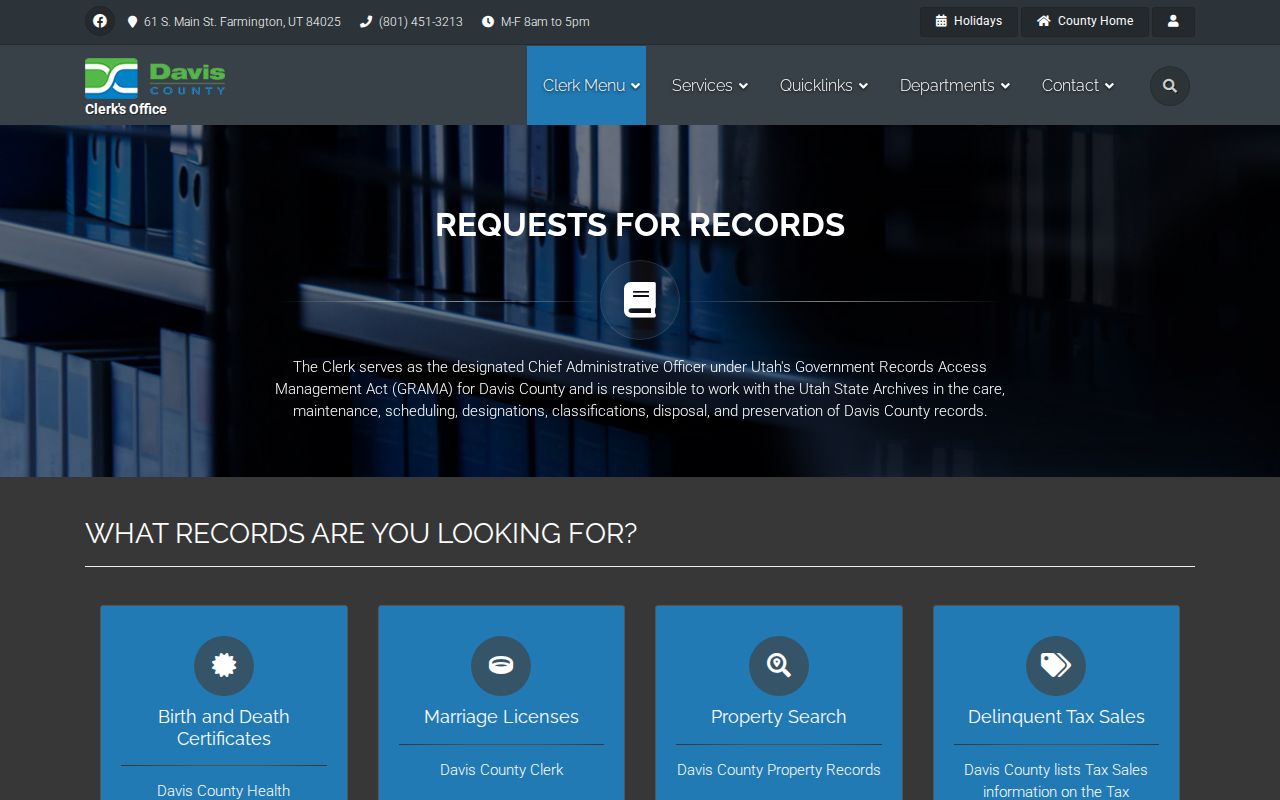
The routing page matters because birth, marriage, property, criminal-history, and divorce requests do not all go to the same desk.
Farmington Court Records Access
Utah Courts Xchange covers public district and justice court summaries statewide. A search can use jurisdiction, case number, last name or company, first name, case type, court scope, birth date, citation details, or a date range. Results can show parties and roles, attorneys, judge, case history, proceedings, judgments, outcomes, fines, and public documents.
Coverage is courthouse-specific. Xchange's official coverage list marks Farmington data complete for filings from May 26, 1998. Older entries may be incomplete, while public district e-documents begin July 1, 2010. The online service is paid, but participating district courthouse and State Law Library terminals offer free searching. The clerk remains the route to an existing case file, copy, or certification.
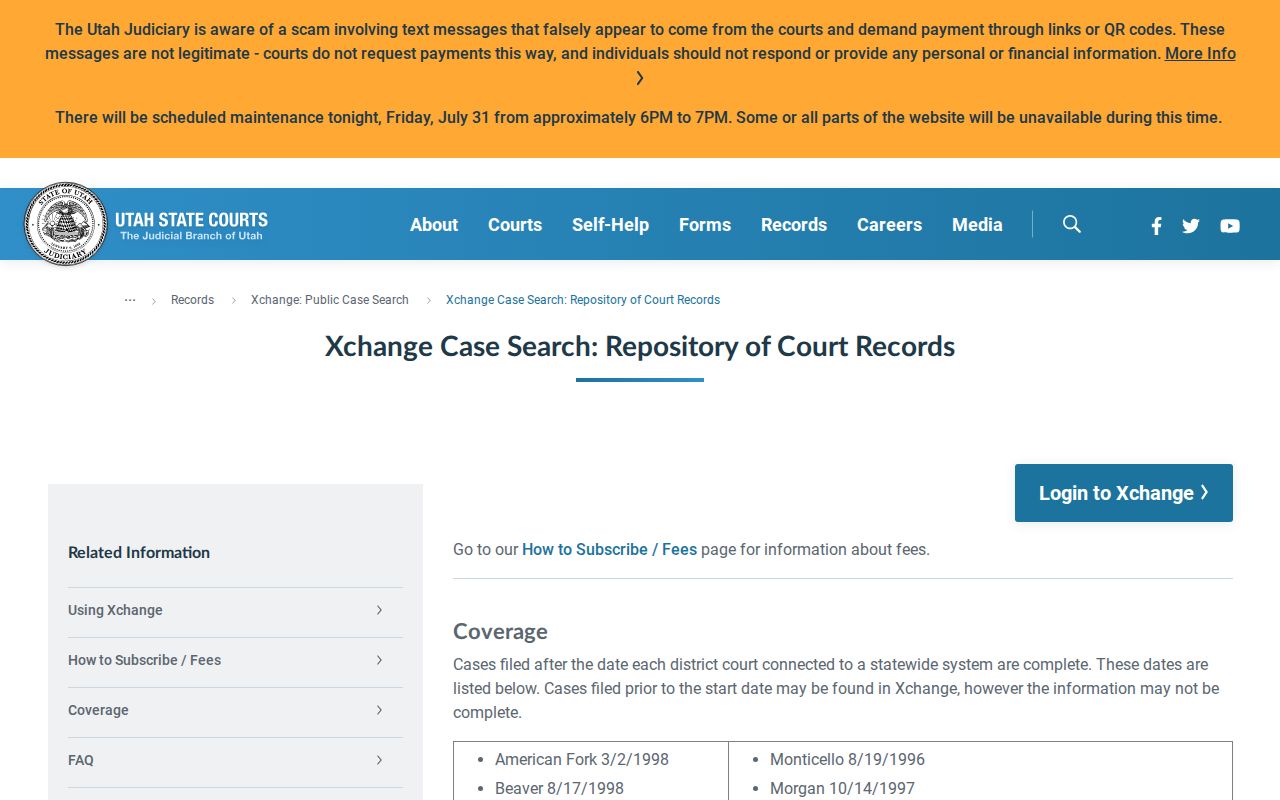
The coverage chart prevents a false no-result conclusion when a Farmington case predates the local system's completeness date.
Farmington Vital Records Boundaries
Current certificates are not open name-browse databases. Davis County Health and the Utah Office of Vital Records and Statistics issue eligible copies after checking identification and relationship. Under Utah Code § 26B-8-125, birth records become public at 100 years and death records at 50 years. The general public may request marriage and divorce certificate material after 75 years.
As of July 1, 2026, Utah lists $25 for an initial birth certificate, $35 for death, and $25 for marriage or divorce. An extra copy of the same record is $10. In-person service is generally immediate, while mail requests can take at least six weeks. The state abstract series covers marriage and divorce from 1978 through 2010. Outside those years, use the Davis County Clerk for marriage and the District Court for divorce.
The Davis County vital-record ordering page provides the local application and identity path.
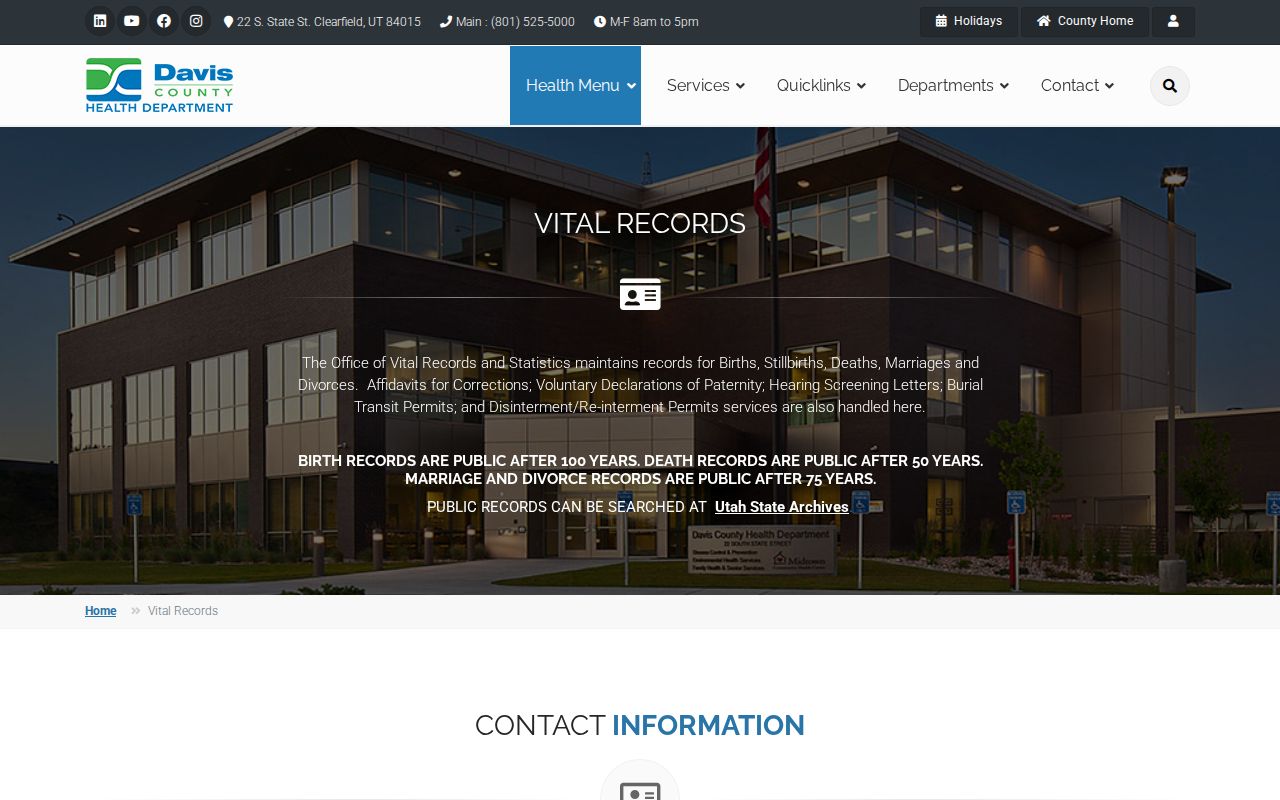
Older genealogical research moves to Utah Archives, including its free Davis County birth register index and images for 1898 through 1905.
Farmington Records Terms Decoded
A portal result and an official copy serve different purposes. These terms help set the right request before a fee is charged.
- Index
- A list of identifying facts that points to a filed record.
- Image
- A scan or electronic view of the filed document itself.
- Certified copy
- A copy authenticated by its custodian for formal use.
- Custodian
- The office that maintains the record and decides access under law.
- Exemption
- A legal rule that permits or requires information to be withheld.
Ask for inspection when viewing will answer the question. Request certification only when an agency or proceeding requires it. Historic material may have moved to Utah Archives even though the original office created the file.
Farmington Police and Custody Records
Farmington City and Davis County use separate law-enforcement request routes. The Farmington Police request page distinguishes a police report, traffic-accident report, photos or video, and non-police GRAMA files. A police report costs $20 per copy, and staff may take up to ten business days to process it.
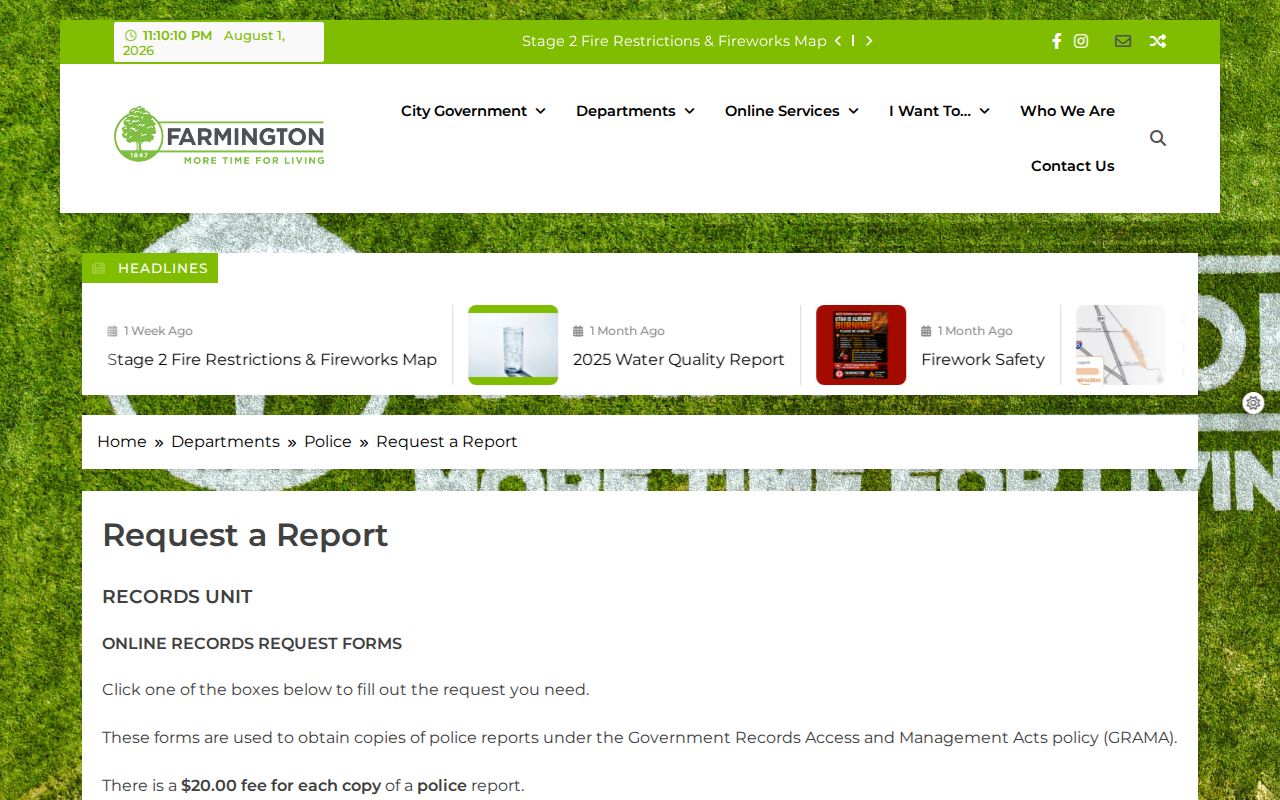
The pictured choices help avoid sending police material to City Hall's general form. Requests can be mailed to the city box or delivered to Police at 286 South 200 East.
The Davis County jail roster is a free current-custody lookup by name. It displays booking date, first and last name, gender, age, and a detail view, but release timing is withheld for safety. Utah DOC's separate offender search covers current state incarceration, probation, or parole. Other releasable Sheriff reports require a form and current photo ID, with a $10 processing fee plus $0.25 per page.
Farmington Records Behind the Numbers
Davis County's September 2024 budget snapshot reported 918 records requests processed and 172,695 documents converted to microfilm. It also recorded 1,670 marriage licenses and 56,916 voter-registration updates. Those figures show why request detail matters: the clerk is both an access counter and a high-volume preservation and elections office.
Note: A document count describes preservation work, not how many records are open to unrestricted public browsing.
Farmington Marriage Records Preserved
A Utah Archives profile describes a long Davis County marriage-record project. Staff digitized 92,799 marriage licenses and 33,000 applications, then rehoused the paper originals in archival folders. The work protects fragile source files and helps staff retrieve an identified record.
Digitization does not turn every application into an unrestricted name database. Current certificate eligibility, record classifications, and any private fields still control release. Begin with the Davis County Clerk for a county marriage license or source record. Use Davis County Health or the state vital office for a certificate abstract from 1978 through 2010, and use archival collections for old material that has reached public status.
Utah GRAMA for Farmington Records
GRAMA requires a request to the governmental entity that maintains the record. A written request should give the requester's name, mailing address, telephone number if available, and a description specific enough to identify the existing record. Include a narrow date range plus a parcel, case, permit, certificate, or document number when known.
The normal response period is ten business days. It is five business days when the requester demonstrates a qualifying public benefit. A government may cite extraordinary circumstances for a large volume, a broad search, legal review, redaction, programming, audit use, serial requests, or a backlog. Fees can cover actual duplication and reasonable staff work, though the first quarter-hour of staff time is free. Prepayment may be required above $50.
Utah's model form asks whether the requester wants inspection or copies, the preferred format, fee or waiver terms, and the basis for access to restricted material. The Utah Open Records Portal provides a central submission route and records-officer search.
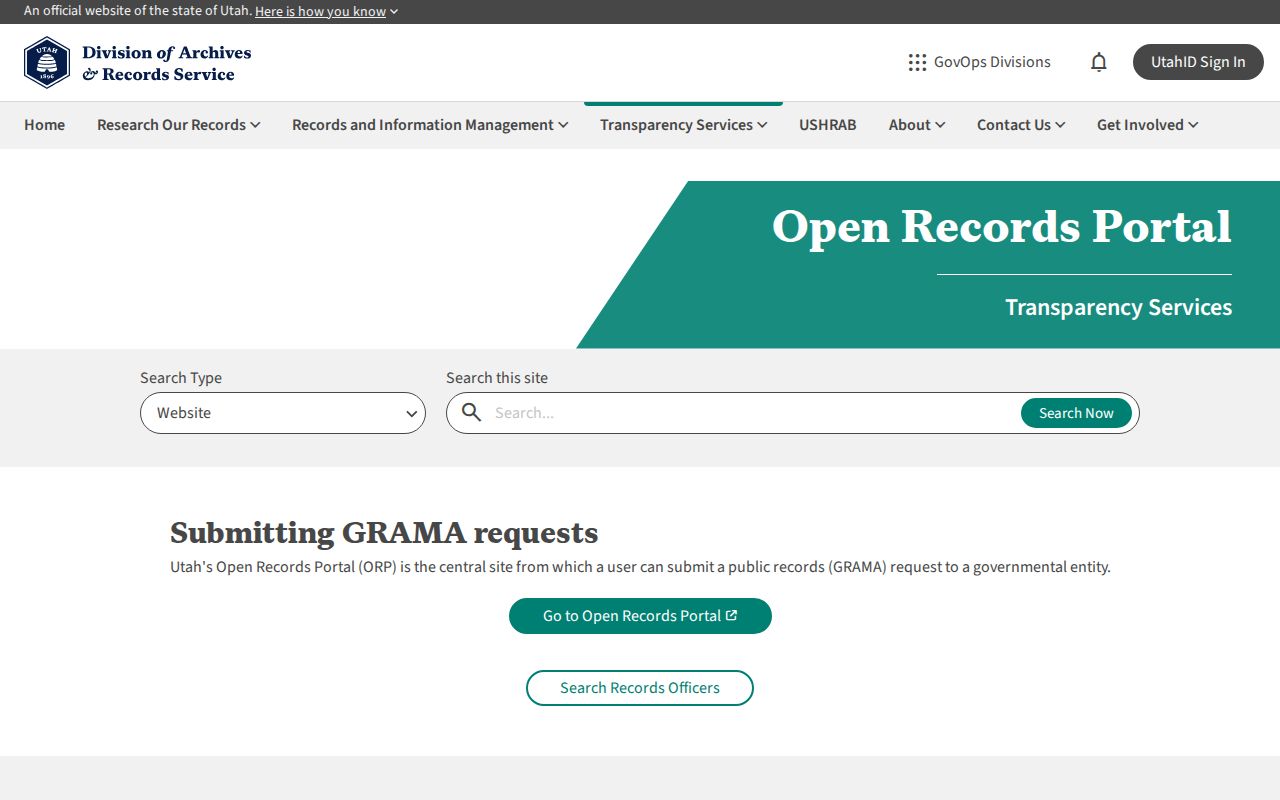
The portal can route a GRAMA filing, but the clearest request still names the correct Farmington, Davis County, court, or state custodian.
Appealing Farmington Records Decisions
A full or partial denial should describe the withheld material as far as possible, cite the legal basis, and explain appeal rights under Utah Code § 63G-2-205. First review normally goes to the entity's chief administrative officer. Utah's official records guidance says that officer generally has ten business days to decide, five for a qualifying expedited appeal, or twelve when a business-confidentiality claimant must receive notice.
Further review may proceed through Utah's Government Records Office or district court as authorized. Current appeal decisions can clarify how agencies conduct a reasonable search, refer a requester to an online record, redact private details, or uphold a protected classification. Preserve the original request, response, and dates. A no-record response may point to the wrong custodian rather than the absence of the record.
File a Farmington Records Request
Start with the free index or agency page, then ask the keeper for a precise existing record. Farmington City uses separate police and non-police forms. Davis County directs land, marriage, health, tax, and court matters to their subject offices, while its “Other Records” path handles material not already assigned.
- Name the custodian. Choose Farmington City, Davis County, Utah Courts, or the state agency that maintains the file.
- Describe the record. Give its series, subject, date span, and any case, parcel, permit, or document number.
- Choose access. State whether inspection, an electronic copy, a paper copy, or certification is needed.
- Set fee terms. Ask for an estimate and place a cost cap before staff begin a broad search.
- Track the response. Narrow an unclear request or use the stated appeal route after a denial.
Lawful personal use. Access does not permit stalking, threats, intimidation, repeated unwanted contact, or evasion of a protected address. Verify changing details with the responsible custodian.
A government office need not create a new analysis. Asking for a recorded warranty deed, case docket, issued permit, or marriage license is far more workable than asking staff to collect everything about a person.