
How Farmington People Searches Work
Choose the first official source by the fact already known. A street address belongs in Davis County Property Search, which links a parcel to an owner, tax mailing address, legal description, and recorded-document history. A full name can go to Utah Courts' Xchange, the Utah business registry, or a professional license search. An older Farmington name may be more productive in the Utah State Archives, the Davis County birth register, or digitized newspapers. Phone-only research usually begins with the sponsored finder above, then moves to official sources for verification.
One result is rarely enough. People can share names, owners do not always occupy a parcel, and a tax mailing address can belong to a trustee or agent. Tie two facts together, such as a middle initial and date, an address and parcel, or a court party and recorded deed. Farmington is the county seat, so several useful counters are close by when a web portal lacks an image or year.
- Write down the name, date, phone number, or Farmington address already known.
- Search the narrowest official index that accepts that fact.
- Read the result fields and note case, parcel, license, or document numbers.
- Confirm the match in a second independent record.
- Ask the correct custodian for an image or certified copy when the index is not enough.
- Parcel
- The county's stable serial number for a piece of land.
- Grantor and grantee
- The person transferring an interest and the person receiving it.
- Docket
- The court's dated list of filings and events in a case.
- Situs address
- The property's physical location, which can differ from its tax mailing address.
Farmington Records Counters by Custodian
County-seat status makes Farmington convenient, but it does not merge the offices. The Davis County Recorder keeps deeds, mortgages, liens, plats, and ownership history. The Clerk handles marriage records, elections, and county GRAMA routing. Farmington's City Recorder handles municipal records, while court clerks control case files. The fuller access-law and copy procedure belongs in the Farmington public records system.
Most county counters in the administration building keep weekday hours from 8 a.m. to 5 p.m. The assessor in Room 302 answers value and classification questions, while the treasurer handles tax status. Birth and death certificates go to Davis County Health in Clearfield, not the Main Street building. Divorce files belong to District Court rather than the County Clerk. Calling the wrong desk can add days to a search, so identify whether the desired item is a recorded instrument, agency record, court file, or certificate first.
Davis County Recorder
61 South Main Street, Suite 106
Farmington, UT 84025
801-451-3225
Davis County Clerk
61 South Main Street, Room 104
Farmington, UT 84025
801-451-3213
Farmington City Recorder
160 South Main Street
Farmington, UT 84025
801-451-2383
Search Farmington Parcels by Address
The free Davis County Property Search is the strongest address-first tool. Type an address or parcel ID and select an autocomplete result, or zoom the map until parcel shapes appear. A typical result joins owner, parcel serial, situs address, legal description, assessed values, tax link, mailing address, property traits, and document or ownership history. The page warns that data can lag by more than a day and is informational, not a legal record.
An owner name is not proof that the same person lives there. Compare the physical, or situs, address with the tax mailing address. A difference can point toward an owner elsewhere, but it may also reflect a trust, agent, or stale mailing choice. The stable parcel number is the best bridge among the recorder, assessor, treasurer, and map.
The county's property-search launch page shows where that trail begins.
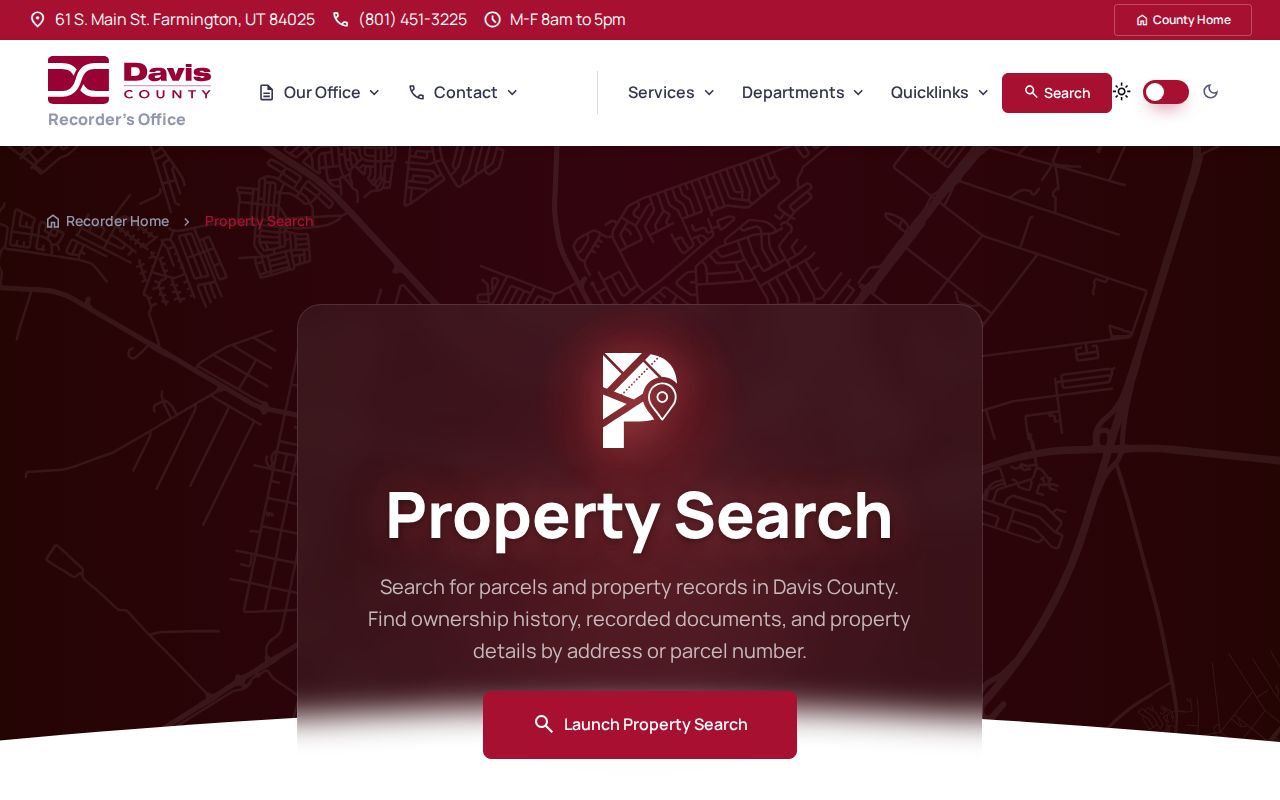
Use the parcel and document numbers shown there to avoid broad name searches at the recorder counter.
| Farmington search input | Best route | Useful result |
|---|---|---|
| Street address | Property Search | Owner, parcel, mailing address |
| Parcel serial | Property Search or GIS | Legal description and linked documents |
| Recorded entry number | REDI or recorder terminal | Abstract or document image |
| Map location | County GIS | Parcel, zoning, aerial layers |
Note: Ownership, value, and tax questions go to different desks even though Davis County presents much of the data in one tool.
Trace Farmington Deeds by Name
A parcel result may display recorded-document and ownership history. Copy its document entry number before moving to REDI-Web or the recorder's public terminal. REDI supports name, address, parcel number, and document number searches, but its advanced abstracts and images require a subscription. The county's current page lists a monthly charge plus a per-document digital fee. A one-time researcher can instead use the free terminal in Suite 106 or request copies by mail or in person.
Read parties in both directions. A grantor transfers the interest; a grantee receives it. Mortgages, releases, liens, and plats can place more names around the same property, but each instrument must be read in context. The recorder says its historic books date from 1870 and that computerization and microfilming began in 1981. It does not publish a reliable earliest online-image year, so an empty online result is not proof that no older record exists.
Farmington addresses may also change form over time. Older deeds can rely on a subdivision, lot, block, or metes-and-bounds legal description rather than today's house number. Recent city ordinances have paired street names with coordinate numbers, including Phoenix Way with 650 West and Arrowgate Drive with part of Commerce Drive. Search both forms, then use the legal description and plat as the lasting link.
Counter shortcut. Bring the parcel serial and document entry number. Those details make a Farmington request far more exact than a common-name search.
Find Farmington Court Names and Files
Utah Courts Xchange searches public district and justice case summaries by party. Search controls include jurisdiction, case number, last name or company, first name, case type, court scope, birth date, citation details, and date range. A docket can show the court, filing date, party role, counsel, judge, proceedings, public orders, outcome, and balances. Farmington coverage is complete for cases filed from May 26, 1998 onward; earlier entries can be incomplete.
Xchange charges online fees, while participating district courthouses and the State Law Library provide free terminals. The Farmington Second District Court hears general civil, domestic, probate, felony, and class A misdemeanor matters. Davis County Justice Court handles lower-level offenses, traffic, and small claims. Sealed, expunged, adoption, civil commitment, and juvenile cases do not appear in the public search. Some family and guardianship details are private even when a public case history remains.
The official Xchange information screen explains the paid web and free terminal channels.
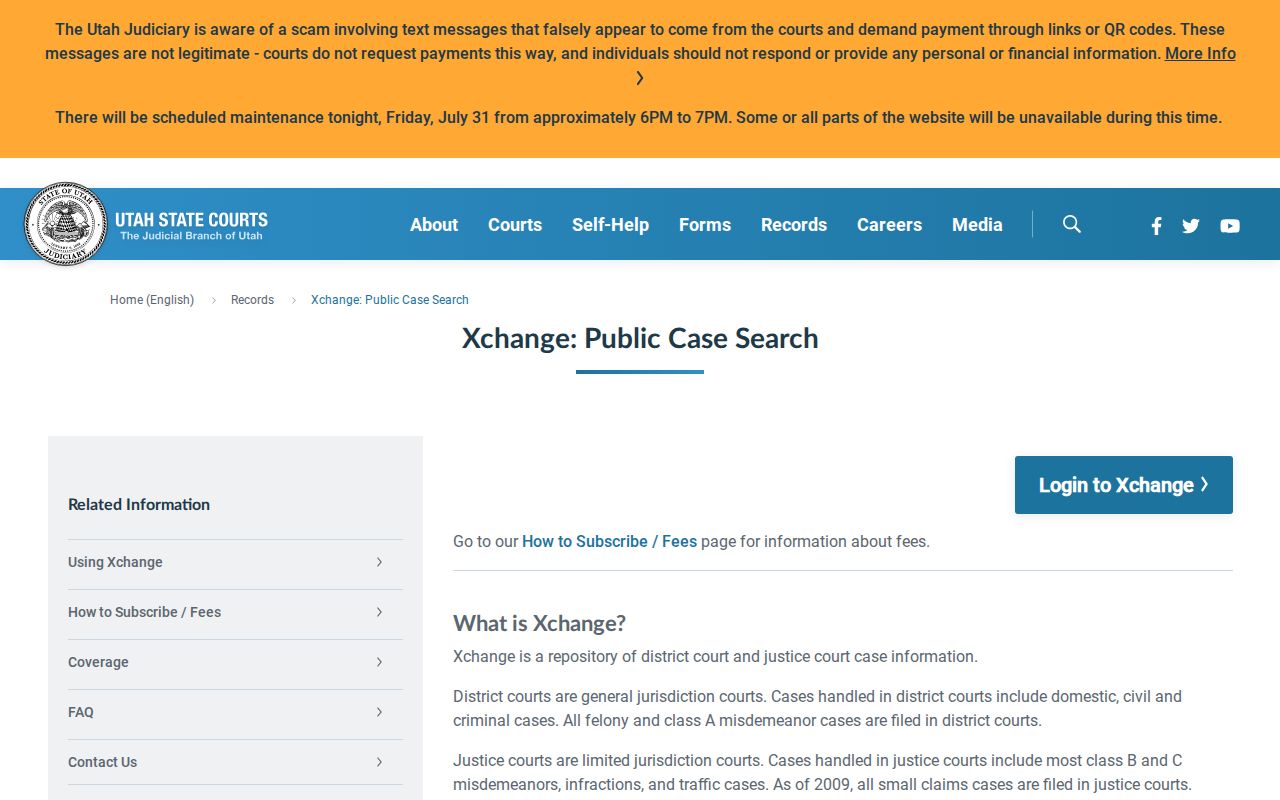
A name match is only an index result. Use the case number and clerk channel to inspect the public file.
| Court | Covers | Name Search | Access |
|---|---|---|---|
| Second District, Farmington | Civil, domestic, probate, felony | Xchange | Paid web or free terminal |
| Davis County Justice Court | Traffic, ordinances, small claims | Xchange | Paid web or free terminal |
| U.S. District Court, District of Utah | Federal cases | PACER | Federal portal and clerk |
Farmington Vital Records and Indexes
Davis County Health serves Farmington certificate requests, while Utah's Office of Vital Records and Statistics holds births and deaths from 1905 forward and marriage or divorce abstracts for 1978 through 2010. Davis County Clerk is the route for county marriage records outside the state abstract span. The Second District Court holds divorce files outside that span. An abstract records core facts; it is not the full decree or court file.
Recent certificates require a qualified relationship, identification, and payment. Under Utah Code § 26B-8-125, birth records become public after 100 years and death records after 50 years. Marriage and divorce certificates generally open after 75 years. The Utah State Archives supplies public historical routes, including a searchable Davis County birth register for 1898 through 1905.
Utah's current fee schedule took effect July 1, 2026. It lists $25 for a birth certificate, $35 for a death certificate, and $25 for a marriage or divorce certificate, with separate expedite and shipping charges. Mail processing can take at least six weeks, while an in-person request is often completed the same day. A search fee is kept even when no matching certificate is found, so verify names, dates, place, and the correct custodian before ordering.
The Davis County birth index combines name searching with downloadable register images.
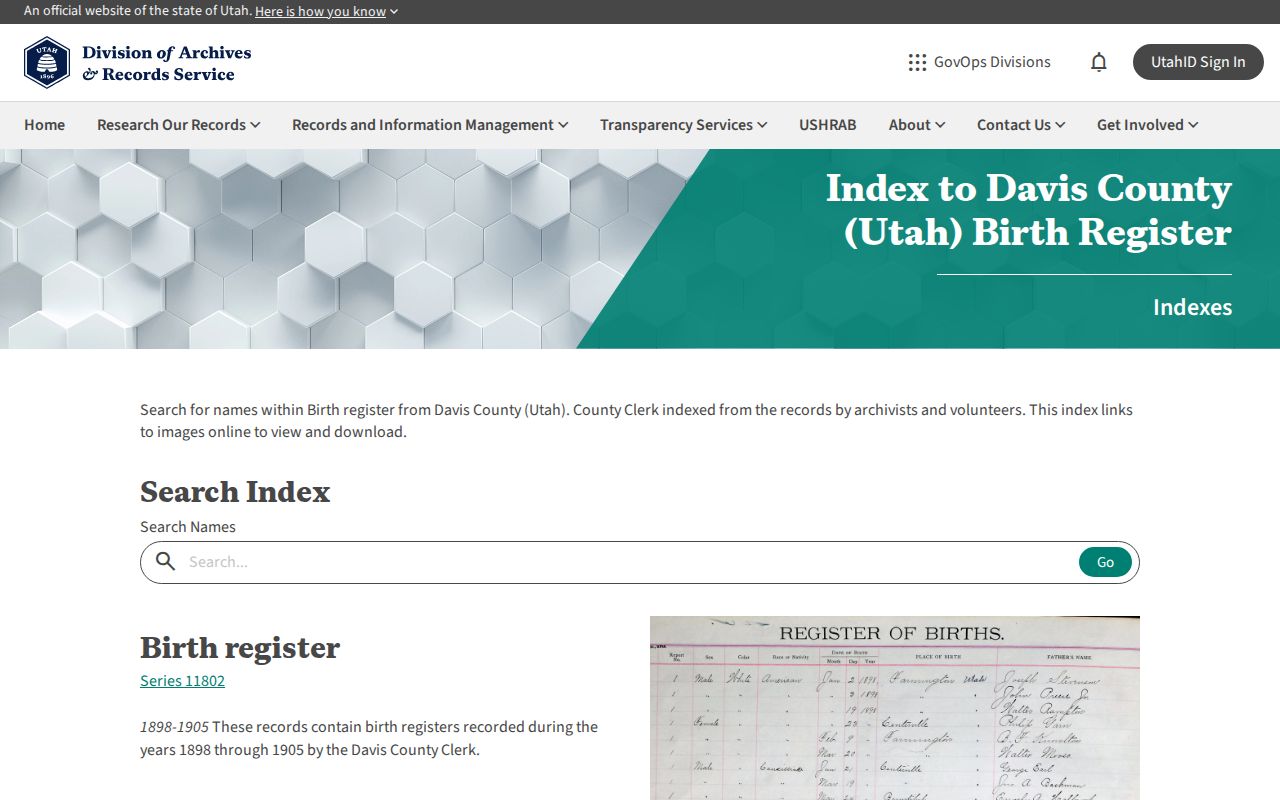
That archive can establish a family fact without treating a restricted modern certificate as a public directory.
Search Farmington Business Names
A business name can lead to a person through Utah filings. The Utah Business Entity Search identifies filed entities and registered principals. The Division of Corporations also provides UCC and central filing searches. Farmington does not publish a public, name-searchable city license roll, so releasable local applications must go through the City Recorder. Do not mistake a state filing for proof that a city permit is current.
Farmington's city application categories include commercial businesses, specified home occupations, mobile businesses, solicitors, temporary businesses, daycare or preschool uses, and special event alcohol activity. Those application records can contain owner or contact names, but access still depends on GRAMA classifications and redaction. The safest request names the business, address, application type, and date span. City warnings also say genuine update messages come from city email or Civic Review, a useful check against phishing demands.
The state entity search screen is the official starting point for registered business names.
Compare the entity name, principal, date, and status with an address or license record before deciding two entries refer to the same person.
Verify Farmington Professional Licenses
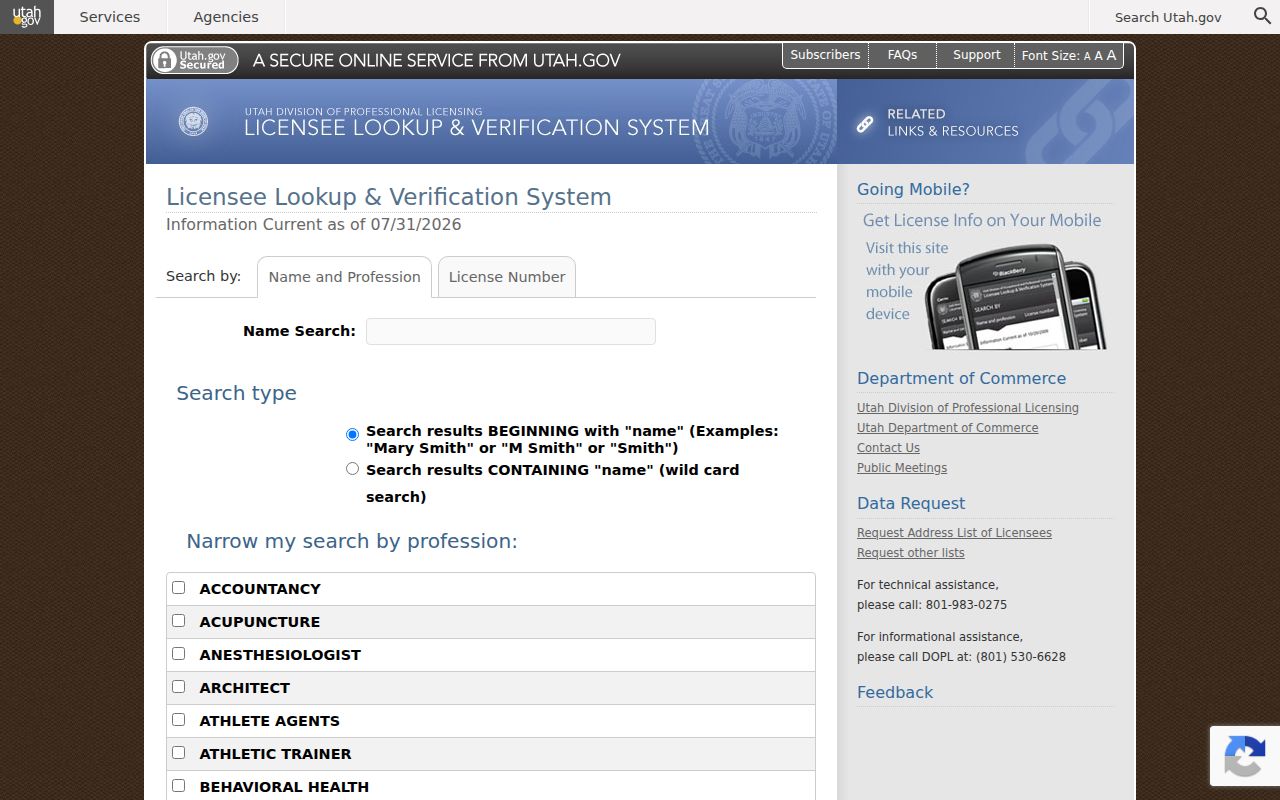
The Utah DOPL Licensee Lookup accepts a name and profession or a license number. It can show license type and current status, creating dated identity evidence for a professional. A separate DOPL disciplinary search should be checked when public enforcement history matters. License verification and discipline are different records, and a shared name alone is not a match.
The official DOPL lookup form offers beginning-with and containing name modes across its profession list.
Insurance agents, educators, notaries, and corporations have separate Utah directories, so use the board that regulates the role.
- DOPL
- Search by name, profession, or license for status and license type.
- Utah Corporations
- Search an entity or principal for a filed business relationship.
- USBE
- Use a name, district, or school to check educator credentials and assignments.
- Notary Search
- Use a name, city, ZIP, or language to find commission details.
Use Farmington City Records Offline
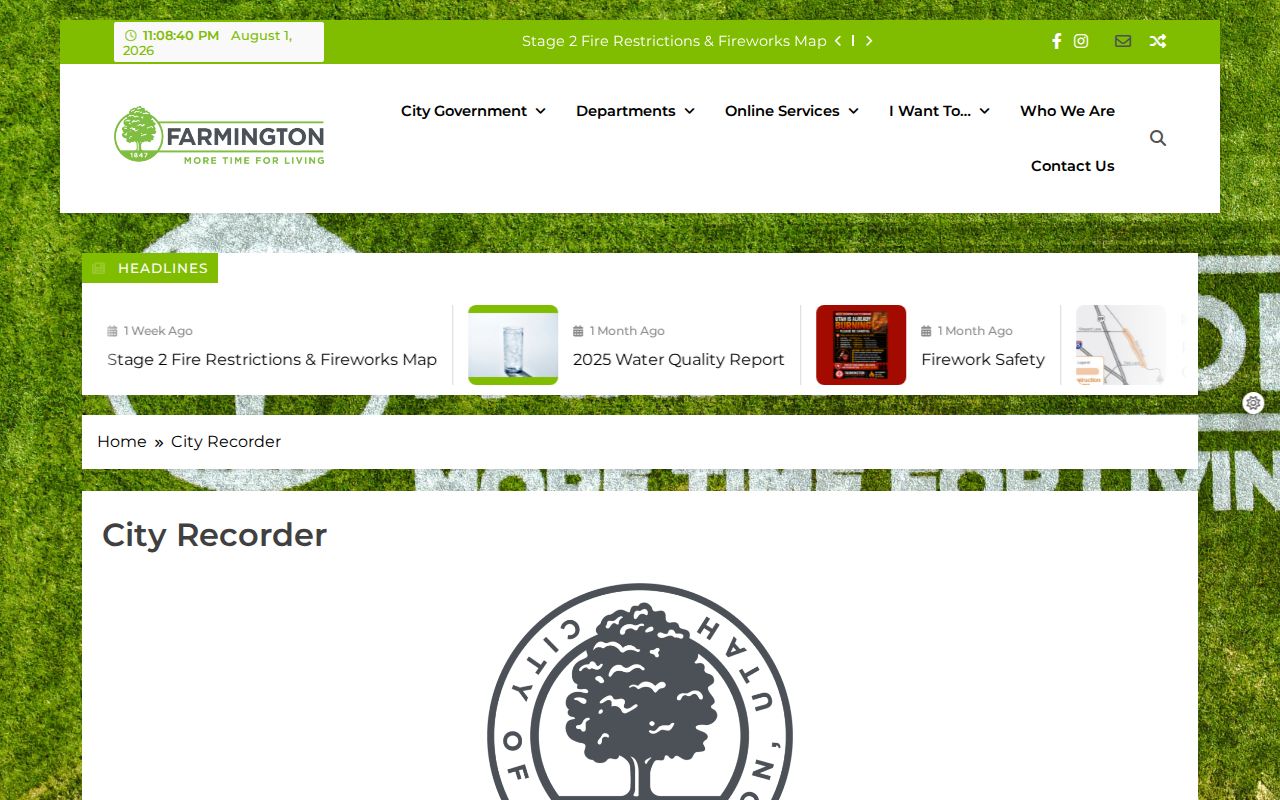
Farmington City separates police and non-police requests. The City Recorder page links both forms. Non-police requests can also be mailed to P.O. Box 160 or delivered to City Hall at 160 South Main. Police requests may be delivered to 286 South 200 East. The city lists up to ten working days, page charges, and added charges for substantial research or media.
The Farmington City Recorder screen directs a requester to the correct form.
Name the department, date range, address, incident, or permit in the request. Staff need a record description, not a broad demand to research a person.
Farmington Voter Records Have Limits
Utah Voter Profile is an identity-checked tool for a voter to confirm registration, polling and ballot details, and elected officials. It is not an open browse of Farmington residents. Standard voter-file data can include name, residential and mailing address, party, age range, districts, status, and election participation, but never how a ballot was marked. Full birth date, identification numbers, signature, email, and phone stay withheld.
At-Risk classification under Utah's 2026 privacy changes withholds qualifying voters' identifying registration data except for official government use. The complete file has statutory access and use rules, while county subsets go through the Davis County Clerk. The end-to-end process is covered on the Farmington voter registration records page.
Utah's full statewide voter file is a large paid download, not an informal name lookup. It can show districts, active or inactive status, last update, and participation history. A county subset comes from Davis County elections in Room 104. Participation means only that a voter took part in an election. Secret ballot choices never appear. Farmington researchers who only need to check their own registration should use Voter Profile rather than seek the bulk file.
Lawful personal use. Public availability never permits threats, stalking, repeated unwanted contact, or an attempt to defeat a protected address.
Follow Farmington Families Backward
Historic work often begins where current portals end. The Utah, Davis County Records, 1869–1953 collection contains 40,381 courthouse images spanning naturalization, birth, death, land, cemetery, marriage, mining, wills, probate, and decree books. Sign-in or access through an affiliate library may be required. Cite the original county series because this is a digitized collection, not a current county portal.
The Davis County historical collection screen offers name, birthplace, birth year, and browse controls.
Probate, an obituary notice, and a deed can form a strong trail for heirs because each source records a different relationship.
Farmington Names Changed with Work
Farmington's directories preserve more than contact details. Historic-district research found 133 named people in the 1879–80 Utah Gazetteer, including 81 farmers. By 1922–23, a directory estimated 1,450 residents and listed a wider mix of retailers, dentists, florists, grocers, a physician, a shoemaker, a contractor, banks, and hotels. Those lists show a settlement changing into a county-seat community.
Davis County Library's Farmington Headquarters has the library system's only published microfilm-reader location, plus scanning and interlibrary loan. No official year-by-year inventory of its city, reverse, phone, yearbook, or obituary holdings was found. Ask staff about exact holdings instead of assuming a year is on the shelf. Utah Digital Newspapers adds 26 Farmington-tagged Davis County Argus issues, but the run is fragmentary.
The newspaper results cluster mainly from September 1904 through May 1905, with issues in 1912. Search names with spelling variants, initials, a street, or an occupation, then filter by year. Legal notices, social items, advertisements, and obituaries can connect a person to a date, but the gaps mean silence proves little. Farmington council minutes beginning in 1906 and historic Second District indexes offer separate government trails when a newspaper run misses the event.
Watch Farmington Property Filings
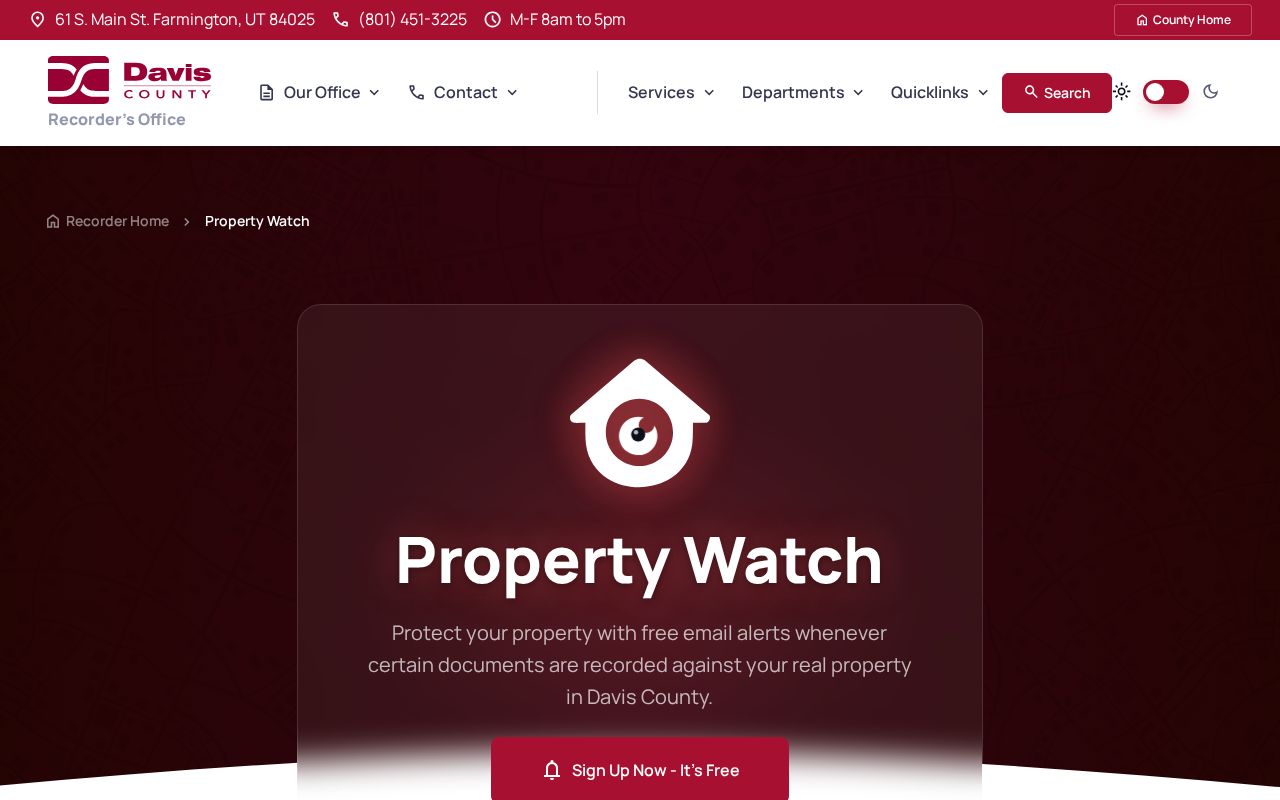
Davis County Property Watch sends notice when a deed or mortgage is recorded against an enrolled property. It is useful when verifying an unexpected filing or guarding against deed-copy scams. The alert does not block a recording, replace title insurance, or prove fraud. The recorder and the actual instrument remain the sources to check.
The county's Property Watch enrollment page explains the free notice service.
A costly deed-copy letter is not an official demand. Compare it with the recorder's posted copy route and phone number before paying.
Check Two Farmington Records
Strong identification comes from overlap. A parcel can supply a mailing address and document number; the deed adds parties and a recording date. A court docket adds a case role and filing date. A license adds profession and status. Historical directories, probate, and newspapers add household or occupation context. No single source proves every claim, and each has a different update cycle.
Official sources are best for their own facts. Commercial finders may combine phone, address, email, and relative data quickly, but they can merge people or retain stale facts. Use the fast result as a lead, then verify it with the agency that created the record.
Check the record's scope as closely as the name. The Davis County jail roster shows current custody, while the Utah Department of Corrections search covers people under state incarceration, probation, or parole. Xchange covers public court case summaries, not juvenile or sealed matters. A professional license speaks to a regulated credential, not every role a person may have held. Clear scope prevents a true result from being used to support a claim it does not make.
| Source type | Strength | Limit |
|---|---|---|
| Official current index | Agency context and identifiers | May omit images or closed fields |
| Archive collection | Older names and original series | Coverage can be partial |
| Commercial finder | Fast combined leads | May be stale or merge identities |
Note: A Farmington name, date, and address that agree across two independent records are more useful than several copies of one index entry.